Friday, September 1, 2023

What is Machine Learning?

Machine learning is a subset of artificial intelligence (AI) that focuses on developing algorithms and models that allow computers to learn and make predictions or decisions without being explicitly programmed. It is a field of study that enables machines to improve their performance on a specific task as they are exposed to more data and experience.

Key concepts and components of machine learning include:

Data: Machine learning relies heavily on data. Algorithms learn from data to make predictions or decisions. High-quality and relevant data is essential for training accurate models.


Algorithms: Machine learning algorithms are mathematical models that are designed to recognize patterns, relationships, or structures in data. Common types of machine learning algorithms include supervised learning, unsupervised learning, and reinforcement learning.

  • Supervised Learning: In this approach, the algorithm is trained on a labeled dataset, where each input data point is associated with a corresponding target or output. The algorithm learns to make predictions or classifications based on the input data and tries to minimize the error between its predictions and the true labels.

  • Unsupervised Learning: Unsupervised learning deals with unlabeled data. Algorithms in this category are used for tasks like clustering (grouping similar data points) and dimensionality reduction (simplifying data while preserving important information).
  • Semi-Supervised Learning: Semi-Supervised Learning lies between Supervised and Unsupervised machine learning. It represents the intermediate ground between Supervised and Unsupervised learning algorithms and uses the combination of labelled and unlabeled datasets during the training period.

  • Reinforcement Learning: This type of learning involves training agents to make sequences of decisions in an environment to maximize a reward. It is commonly used in robotics and game playing. Reinforcement learning works on a feedback-based process, in which AI software explore surrounding and improve its performance. The reinforcement learning process is similar to a human being;


Feature Engineering: Feature engineering is the process of selecting and transforming the relevant features (input variables) from the raw data to improve the performance of machine learning models. Effective feature engineering can significantly impact the model's accuracy.

Training and Testing: Machine learning models are trained on a portion of the dataset called the training set. The model's performance is evaluated on a separate portion called the testing or validation set to assess its generalization capabilities.

Model Evaluation: Various metrics are used to evaluate the performance of machine learning models, depending on the specific task. Common evaluation metrics include accuracy, precision, recall, F1-score, and mean squared error.

Hyperparameter Tuning: Machine learning models often have hyperparameters that need to be set before training. Hyperparameter tuning involves finding the best combination of hyperparameters to optimize model performance.

Deployment: After a model is trained and evaluated, it can be deployed in real-world applications to make predictions or automate decision-making processes. Deployment may involve integrating the model into a software application or a production system.

Machine learning has applications in various domains, including natural language processing, computer vision, healthcare, finance, recommendation systems, and autonomous vehicles, among others. It has the potential to transform industries and solve complex problems by leveraging the power of data and computation to make predictions and automate tasks.


Monday, May 29, 2023

BeautifulSoap

 BeautifulSoap Library in Python

    The Beautiful Soup library is a popular Python library used for web scraping and parsing HTML or XML documents. It provides a convenient way to extract data from web pages by navigating the parsed document tree and searching for specific elements or patterns.

    To use Beautiful Soup, you'll first need to install it. You can do this using pip, the Python package manager, by running the following command:

pip install beautifulsoup4

    Once installed, you can import Beautiful Soup into your Python script or interactive session using the following import statement:

from bs4 import BeautifulSoup


Example :-
from bs4 import BeautifulSoup

# HTML document
html_doc = '''
<html>
<head>
    <title>Example</title>
</head>
<body>
    <h1>Heading</h1>
    <p class="content">Paragraph 1</p>
    <p>Paragraph 2</p>
</body>
</html>
'''

# Create a BeautifulSoup object
soup = BeautifulSoup(html_doc, 'html.parser')

# Extract specific elements
title = soup.title
heading = soup.h1
paragraphs = soup.find_all('p')

# Print the extracted data
print("Title:", title.string)
print("Heading:", heading.string)
print("Paragraphs:")
for p in paragraphs:
    print(p.string)

Output :-


    In the above example, we create a BeautifulSoup object by passing the HTML document and the parser type ('html.parser') to the constructor. We can then use various methods and attributes provided by Beautiful Soup to navigate and extract data from the parsed document.
    In this case, we extract the title element using soup.title and the heading element using soup.h1. We also find all the <p> elements using soup.find_all('p'). The extracted data can be accessed through the string attribute of each element.

Beautiful Soup also provides a wide range of methods and features for searching, filtering, and manipulating the parsed document tree. 

Sunday, May 28, 2023

Concept Of Encapsulation

 ENCAPSULATION

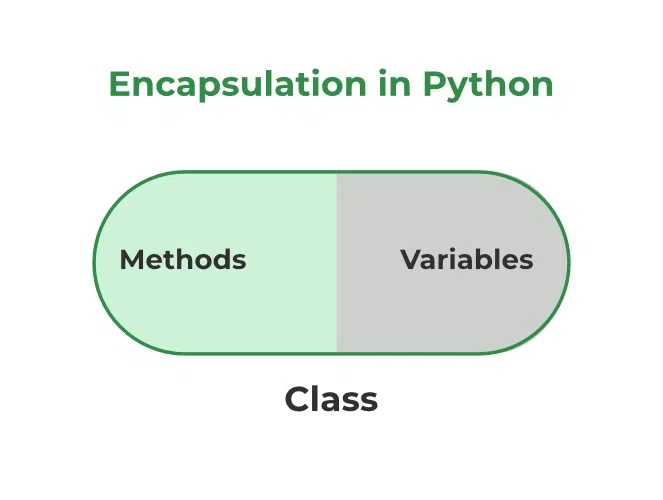
    Encapsulation is one of the fundamental concepts in object-oriented programming (OOP). It describes the idea of wrapping data and the methods that work on data within one unit. This puts restrictions on accessing variables and methods directly and can prevent the accidental modification of data. To prevent accidental change, an object’s variable can only be changed by an object’s method. Those types of variables are known as private variables.
    Encapsulation also helps in achieving modularity and code maintainability. Since the internal implementation details are hidden, changes to the internal representation of an object can be made without affecting the code that uses the object. This allows for easier updates and modifications to the codebase, as the external code only relies on the public interface of the object.
    In many programming languages, encapsulation is implemented using access modifiers such as public, private, and protected. These modifiers control the visibility and accessibility of class members (variables and methods). Private members are only accessible within the class itself, while public members can be accessed from any code that has a reference to the object.
    A class is an example of encapsulation as it encapsulates all the data that is member functions, variables, etc. The goal of information hiding is to ensure that an object’s state is always valid by controlling access to attributes that are hidden from the outside world.

Note: The __init__ method is a constructor and runs as soon as an object of a class is instantiated.  


Example :-

class bank_account:
def __init__(self):
self.balance = 0
self.name = ''

def welcome(self):
self.name = input('Welcome to your Bank Account. Please Enter your name : ')
        
    # #balance check
def get_balance(self):
print('Your Current balance : {}'.format(self.balance))
        
    #deposit amount
def deposit(self):
self.balance += float(input('Hello {}, please enter amount to deposit : '.format(self.name)))
self.get_balance()
        
    ##withdraw amount
def withdraw(self):
amount_to_withdraw = float(input('Enter amount to withdraw : '))
if amount_to_withdraw > self.balance:
print('You Have Insufficient Balance !!')
else:
self.balance -= amount_to_withdraw
self.get_balance()


if __name__=="__main__":
bank_account = bank_account()
bank_account.welcome()

while True:
input_value = int(input('Enter 1 to see your balance,\n2 to deposit \n3 to withdraw\n'))

if input_value == 1:
bank_account.get_balance()
elif input_value == 2:
bank_account.deposit()
elif input_value == 3:
bank_account.withdraw()
else:
print('Please enter a valid input.')
        

OUTPUT :-


Friday, May 26, 2023

SQL and NoSQL databases

  Concept Of  SQL and NoSQL databases.


    A database is information that is set up for easy access, management and updating. Computer databases typically store aggregations of data records or files that contain information, such as sales transactions, customer data, financials and product information.
    Databases are used for storing, maintaining and accessing any sort of data. They collect information on people, places or things. That information is gathered in one place so that it can be observed and analyzed. Databases can be thought of as an organized collection of information.


SQL :-
  • RELATIONAL DATABASE MANAGEMENT SYSTEM (RDBMS)
  • These databases have fixed or static or predefined schema
  • These databases are not suited for hierarchical data storage.
  • These databases are best suited for complex queries
  • Vertically Scalable
  • Follows ACID property
  • Examples: MySQL, PostgreSQL, Oracle, MS-SQL Server, etc.

NoSQL :-
  • Non-relational or distributed database system.
  • They have dynamic schema
  • These databases are best suited for hierarchical data storage.
  • These databases are not so good for complex queries
  • Horizontally scalable
  • Follows CAP(consistency, availability, partition tolerance)
  • Examples: MongoDB, GraphQL, HBase, Neo4j, Cassandra, etc.

Order Of Execution Of Clauses

  1. FROM - Tables are joined to get the base data.
  2. WHERE - The base data is filtered.
  3. GROUP BY - The filtered base data is grouped.
  4. HAVING - The grouped base data is filtered.
  5. SELECT - The final data is returned.
  6. ORDER BY - The final data is sorted.
  7. LIMIT - The returned data is limited to row count.

Multiprocessing

What is Multiprocessing?  Multiprocessing refers to the ability of a system to support more than one processor at the same time. Application...

Popular